
 Login with Google
 Your Shopping Cart is empty!
  App store
 Google Play
You've had a hard day at work and feel drained of your energy. While driving back home, you think that a piece of chocolate would make you feel delighted and energized. So, the first thing you do is open the refrigerator to grab a bite of chocolate or a cupcake.
The other day, you attended a friend's birthday and were happy to breathe in the sweet aroma of a live birthday cake.
At lunch with a colleague, a sweet snack on your plate felt like a precise solution to the afternoon energy slump.
These are just a few examples of what people fond of sweet foods feel across cultures and age groups. An affinity for sweet foods is a natural expression of love and emotions. Craving for sweets and related food types is so normal that we rarely think about why we like sweet food so much.
Is taste the only acceptable reason behind our cravings for sweets? Actually, no, because the answer goes far beyond simple taste.
Welcome to this sweet world where we discuss the science behind sweet cravings. Our discussion will involve biology, human evolution, brain chemistry, and psychology, all put together, which celebrates the important role sweet foods have played in human survival for centuries. Fortunately, we are still attached to our roots, and our brains still respond positively to them.
Everybody loves sweets is a more generalized statement. Still, it is essential to understand why we humans crave sugar and the substantial role sweet food psychology plays in helping us make smarter food choices.
If you still enjoy sweets, then let loose fantasies as we explore the fascinating science behind our love for sweet foods across cuisines.
Sweet Taste: One of Our First Food Experiences
We have known the taste of sweetness right from our very first day on this Earth. Our relationship with sweetness is unique, and we have known it immediately after birth in the form of mother's milk and her unconditional love. Mother's milk actually tastes sweet because it contains lactose. Lactose is a form of sugar that carries a mildly sweet taste and provides energy to the baby. As a result, sweetness has become an integral part of every individual and the very first flavor that babies experience and remember.
When a baby is exposed to the sweet taste since birth, it contributes to developing a sweet taste in them. This is the core reason why babies like sweet foods. Baby foods are mostly sweet in taste, but they also carry the necessary ingredients that are essential for their complete growth and development, providing them with the right amount of nourishment and energy.
This natural preference for sweetness goes beyond childhood and often continues into adulthood. Not just kids and adults, but even senior citizens have an affinity for sweets because they trigger essential feelings of comfort, safety, and satisfaction in them. Sugar in the right proportions is essential for our brain to function well. Our association with the sweet taste has been delivering positive experiences from an early age to our last breath.
Nothing happens overnight. Our sugar-consuming habit has been catalytic in shaping human taste preferences since early childhood days. That's the secret behind making sweet flavors our first appealing foods that can never be replaced.
The Evolutionary Reason We Crave Sweet Foods
Anything and everything that happens in this world happens for a reason and has a history associated with it. Hence, we must understand the evolutionary reason for sugar cravings in humans. But to have the crux of it, we need to travel back in time to know how early humans survived when there were limited food options available.
Centuries ago, when knowledge and understanding were scarce, finding reliable food sources was a daily challenge. Sweet foods, especially fruits, were the most sought-after and appreciated foods. These fruits were a primary source of calories, vitamins, and minerals that made them highly valued in those times and even today.
Fruits are the simplest foods that can be easily digested and converted to energy. Their conversion story starts right in our mouths. Because these sweet foods were often rich in nutrients and safe to eat, humans perceived them as their best resource to survive and thrive. It is this same mindset that has continued even after years of evolution. Our love for fresh, sweet foods is so deeply rooted that it is no longer questionable; on the contrary, this affection has become a part of our DNA, which is being transferred from generation to generation.
Anything that's a part of our DNA becomes our second nature. That's the exact reason why humans like sugar. With time, humans started acknowledging that sweetness is a natural signal that highlights a food source as a powerhouse of energy and is essential for one's growth and survival.
Another concept suggests that many poisonous plants and harmful substances that are unsafe and shouldn't be consumed taste bitter. Over time, humans with improved intelligence and wisdom developed a tendency for those foods that taste sweet while cautiously keeping bitter flavors at bay.
This evolution of sweet taste has helped our ancestors identify calorie-rich foods essential for their chances of survival. Even today, we are attracted and awestruck by the wondrous characteristics of sweet foods that are deeply embedded in our biological roots.
What Happens in Your Brain When You Eat Something Sweet?
Our brain counts sweet foods as its friend, and the moment you bite into them, our brain springs into action.
Why do we feel happy when eating something sweet? The simple reason is that our brain releases dopamine, commonly known as the happy hormone, sending signals of happiness all across our body. Dopamine is a neurotransmitter meant to offer you pleasure, motivation, and reward. When you consume a sweet food, the brain orders an increase in your body's dopamine levels. This boost brings happiness, enjoyment, and satisfaction. It also makes you want to eat more sweet foods. Isn't it amazing?
Your brain reacts to sweet foods by rewarding you with happiness. Your brain essentially instructs the body, "Eating feels good, remember it." Hence, it is a common perception that most people associate sugar with happiness. An elevated mood is usually temporary, but the pleasure that one experiences is beyond words. This pleasure not only motivates people to relish sweet foods again but also makes these happy experiences a significant part of their memories with time.
Where once sweet foods were considered a support system for survival, today they have transformed into a natural biological reward system meant to reinforce decent behaviors and great characters in the human race.
Why Sweet Foods Often Feel Comforting
The taste of sweetness has always been associated with human emotions. This indicates that consuming sweet foods goes beyond satisfying hunger.
There is a concept called comfort food psychology, which means that certain sweet treats make individuals feel comforted even under stressful conditions or during emotional turmoil. While you dine at a restaurant, dessert always arrives towards the end. This is done for the simple reason that most people associate sweets with positive experiences they had during childhood. Even after one leaves the dining venue, the sweet aftertaste still stays fresh in their mouth, keeping them feeling happy and in their best mood. You would witness the same instances at family gatherings, during holidays, and at social celebrations.
Sweets have an emotional connection with the human brain, and they can influence the emotional habit of eating sweets. Overcoming stress, anxiety, and sadness becomes way too easy with sweets. Hence, people often reach for sweet foods to achieve temporary relief and comfort from such atrocious emotions.
How are sugar and human moods connected? As such, you won't find a physical connection between them, yet sugar and mood are both biologically and psychologically interconnected. The pleasurable sensation that one experiences is the outcome of their brain's response to personal memories, making sweets a wholesome reason for comfort.
If the discussion till this point has answered the common question, why do sweets make us happy, then it's time for you to grab your favorite pineapple or chocolate sliced cake with a cup of coffee, because you shouldn't search for a reason to be happy; instead, you create one by combining brain chemistry, emotional associations, and learned behaviors.
Natural Sugars vs. Added Sugars: What's the Difference?
Whether sugars are good or bad has always been an arguably controversial question; so, let's look at it from a different perspective. Remember that all sugars aren't created equal because natural sugars are different from added sugars.
Before we understand their basic difference, let's know where these sugars come from.
Natural Sugars:
Foods such as fruits, milk, and honey are a great source of natural sugars. Along with sugar, these foods also provide vitamins, minerals, fiber, and other nutrients beneficial to the human body.
Added Sugars:
Sugars of this type are artificially prepared, processed, and incorporated into foods during their preparation. Common food sources that contain added sugars are ice creams, candies, chocolates, soft drinks, pastries, and many packaged snacks, processed drinks, and juices. Added sugars are an unhealthy substitute for natural sugars and must be avoided to a greater extent.
It is important to understand what added sugar is if you want to make informed choices. Natural sugars never come as a stand-alone product. On the contrary, they come packaged inside some food that also possesses valuable nutrients, vitamins, and fiber. Sadly, added sugars mostly contribute to empty calories without significant nutritional benefits. Added sugars are manufactured and sold as a stand-alone product.
The best comparison can be between sugar in fruits vs candy. Fruits are naturally sweet, whereas candies are artificially sweetened. The candies might mimic the color, taste, flavor, and perhaps the shape of a fruit, but they deliver zero health benefits to consumers. Another example is that of an apple. When you bite into an apple, it provides fiber, vitamins, great taste, and hydration. In contrast, candies typically contain added sugars that are processed in factories and deliver little to no nutritional value.
With a view to increasing their shelf lives, these candies may contain chemical-based and unhealthy stabilizers and preservatives. Hence, choosing healthy sources of sugar is a superior choice as it satisfies both sweet cravings and supports overall health.

Can Sweet Cravings Be Controlled?
Even nectar in excess quantities can be harmful; hence, it is essential to control its consumption. Despite the benefits of natural sugars, cravings must be controlled.
Here, the good news is that cravings can be managed without stressing out or eliminating sweets from your diet.
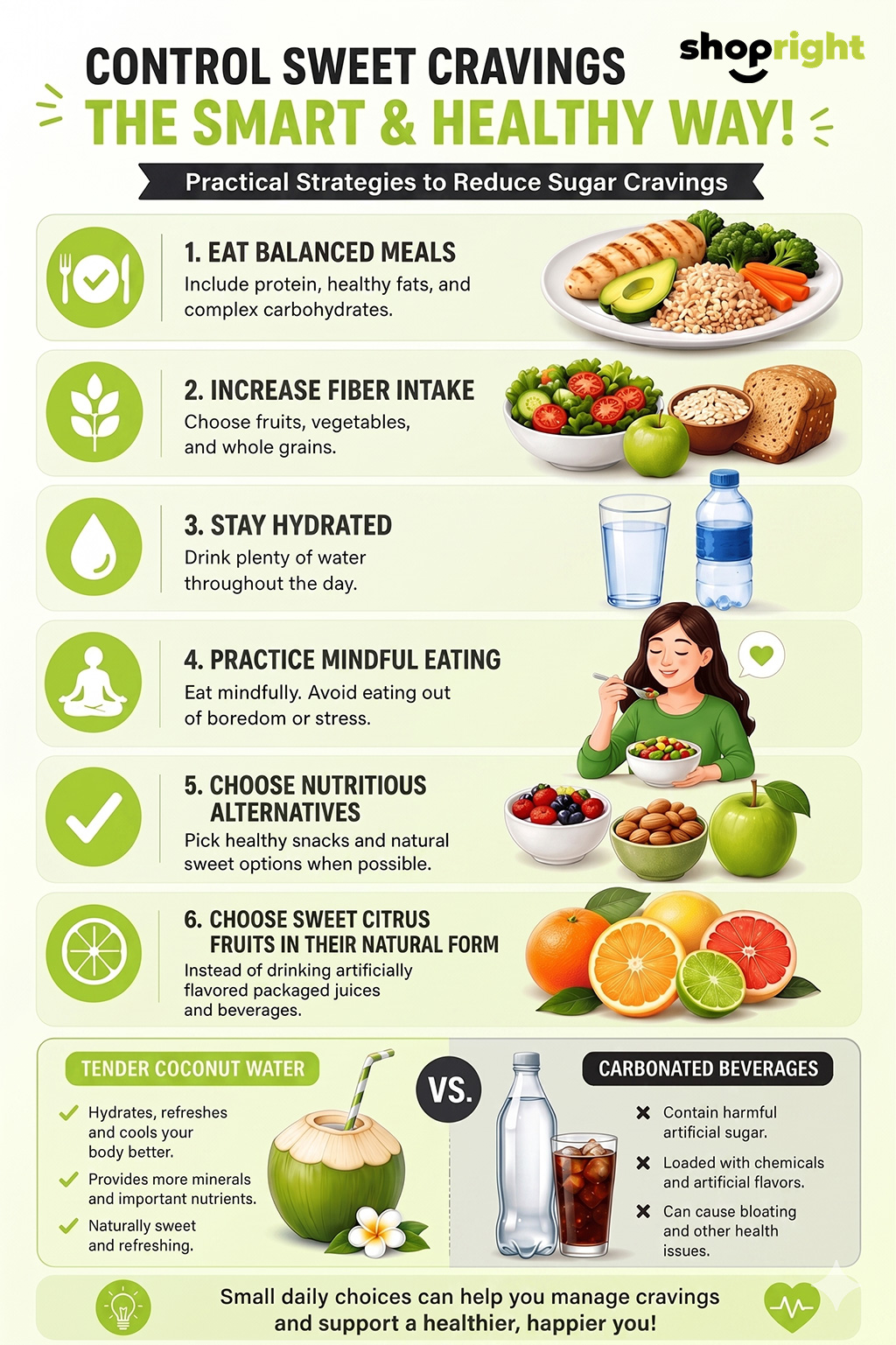
If you honestly feel that your sweet cravings are crossing the limits, then you must consider the following practical strategies that help you reduce sugar cravings.
- Eat balanced meals containing protein, healthy fats, and complex carbohydrates.
- Increase fiber intake through fruits, vegetables, and whole grains.
- Stay properly hydrated throughout the day.
- Practice mindful eating instead of eating out of boredom or stress.
- Choose nutritious alternatives when possible.
- Try eating sweet citrus fruits in their natural form instead of drinking artificially flavored packaged juices and beverages.
Tender coconut water hydrates, refreshes, and cools your body better than carbonated beverages. While coconut water provides more minerals and important nutrients along with a sweet taste, carbonated drinks deliver harmful artificial sugar and chemical-laden flavors to your body.
When you decide to control your sweet cravings, you are actually not stopping your sweet food intake forever. The real idea is to develop sustainable, healthy eating habits that bring down the intensity and frequency of your sweet cravings.
The following image shows simple sugar-craving tips to help you maintain balance without feeling deprived of sweets.
The Role of Sweet Foods in a Balanced Lifestyle
It's a myth that sweet food is an enemy and should be expelled from your diet. When nature has created sweet foods, they have a purpose.
If at all you have doubts about consuming them, simply establish a healthy relationship with sugar. Instead of excessive intake, welcome occasional sweet treats by making them a part of your nutritious diet plan. Some amount of constraint is essential, but a purely restrictive approach may cause frustration and increase your cravings. Be kind to yourself.
Sweet is not the only taste you should savor. Try focusing on eating a balanced diet with sweets. Adopting an approach of moderation and portion awareness will ensure better health and a sustainable lifestyle. People who adopt healthy eating moderation enjoy their favorite treats without guilt. Healthy and hygienic food is essential for life; hence, it should be enjoyed without fear. A balanced, healthy eating habit will not only maintain long-term health but also let you enjoy sweets responsibly and appreciate foods you love and cherish.
Choosing Smarter Sweet Options for Everyday Enjoyment
Switching to smarter choices will eventually help you manage your sweet cravings and also provide you with nutritional benefits on the go.
Here is a list of some exceptionally healthy sweet snacks that you can try today:
- Fresh fruits
- Yogurt topped with berries
- Dark chocolate in moderation
- Homemade fruit smoothies with zero added sugar
- Oat-based energy bites
Once you practice eating these healthy sweet foods, you too will agree that they are far better alternatives to candy and chocolates. The enjoyable sweetness these foods deliver is a pure bonus. Contrary to artificially sweetened food products, many nutritious sweet foods contain fiber, protein, vitamins, and minerals, making them an overall healthy package. If you're looking for healthy dessert ideas for your family gathering, health volunteers at Shopright can suggest combinations where you can blend naturally sweet ingredients with wholesome foods to achieve your family's health goals.
Similar Blog: Easy Homemade Desserts You Can Make in Under 30 Minutes
Find Sweet Treats and Everyday Essentials at Shopright
Whether you're looking for occasional treats or nutritious alternatives, Shopright offers a wide range of products to suit every preference. From fresh fruits and vegetables to healthy snacks and classic sweet treats, shoppers can find products that support balanced eating habits.
If you're interested in healthy grocery shopping, we offer fresh produce, dairy products, pantry staples, and wholesome snacks, all under one roof. For those searching for snacks and candy in Cayman, Shopright provides a diverse selection and makes it easy to explore healthier alternatives.
As a trusted grocery store in the Cayman Islands, Shopright helps customers make informed choices that fit their lifestyles and nutritional goals.
Conclusion
Our love of sweet foods is deeply rooted in biology, evolution, and brain chemistry. From our earliest experiences with sweetness as infants to the brain's powerful reward system, humans are naturally inclined to enjoy sweet flavors.
Understanding the science behind sweet cravings shows that they are normal and have important biological origins.
The key is to maintain a balanced diet. By understanding your body's requirements, choose nutrient-rich options where possible. Instead of taking in excess of foods, it is advisable to practice moderation. Practicing moderation will also help you enjoy sweet foods without guilt or compromising your overall health.
Sweet foods should absolutely earn a place in your healthy lifestyle, with the condition that they are consumed mindfully and responsibly.